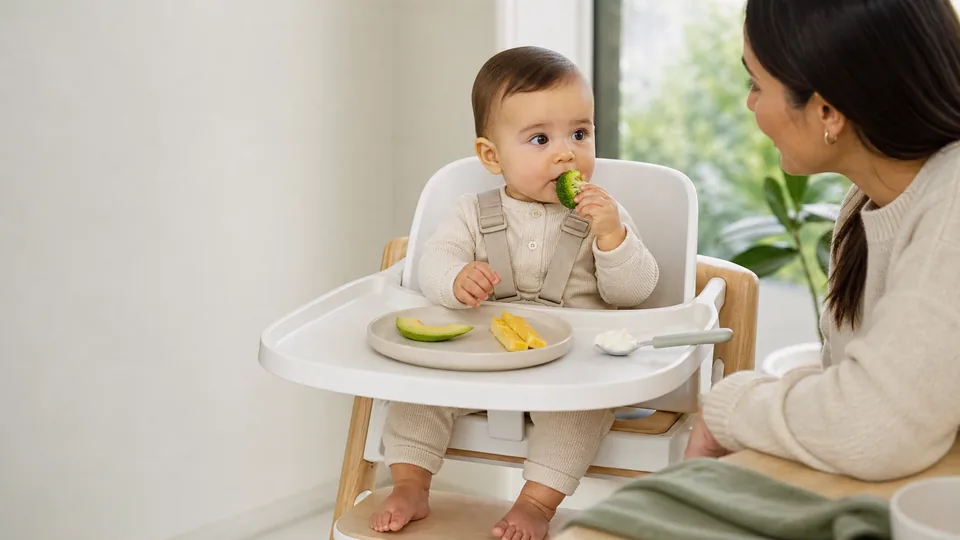

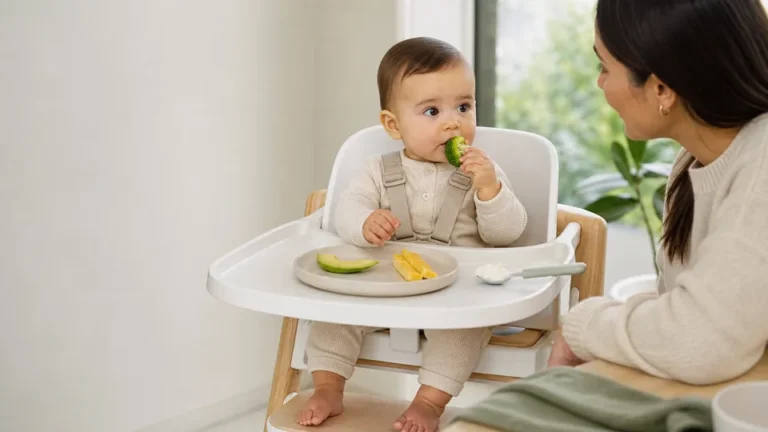
Baby-led weaning is often shown as a six-month-old happily holding broccoli while the family eats the same meal. Real life is messier: some food is swallowed, much of it is squeezed or dropped, and caregivers still need to think carefully about nutrition, texture and choking hazards.
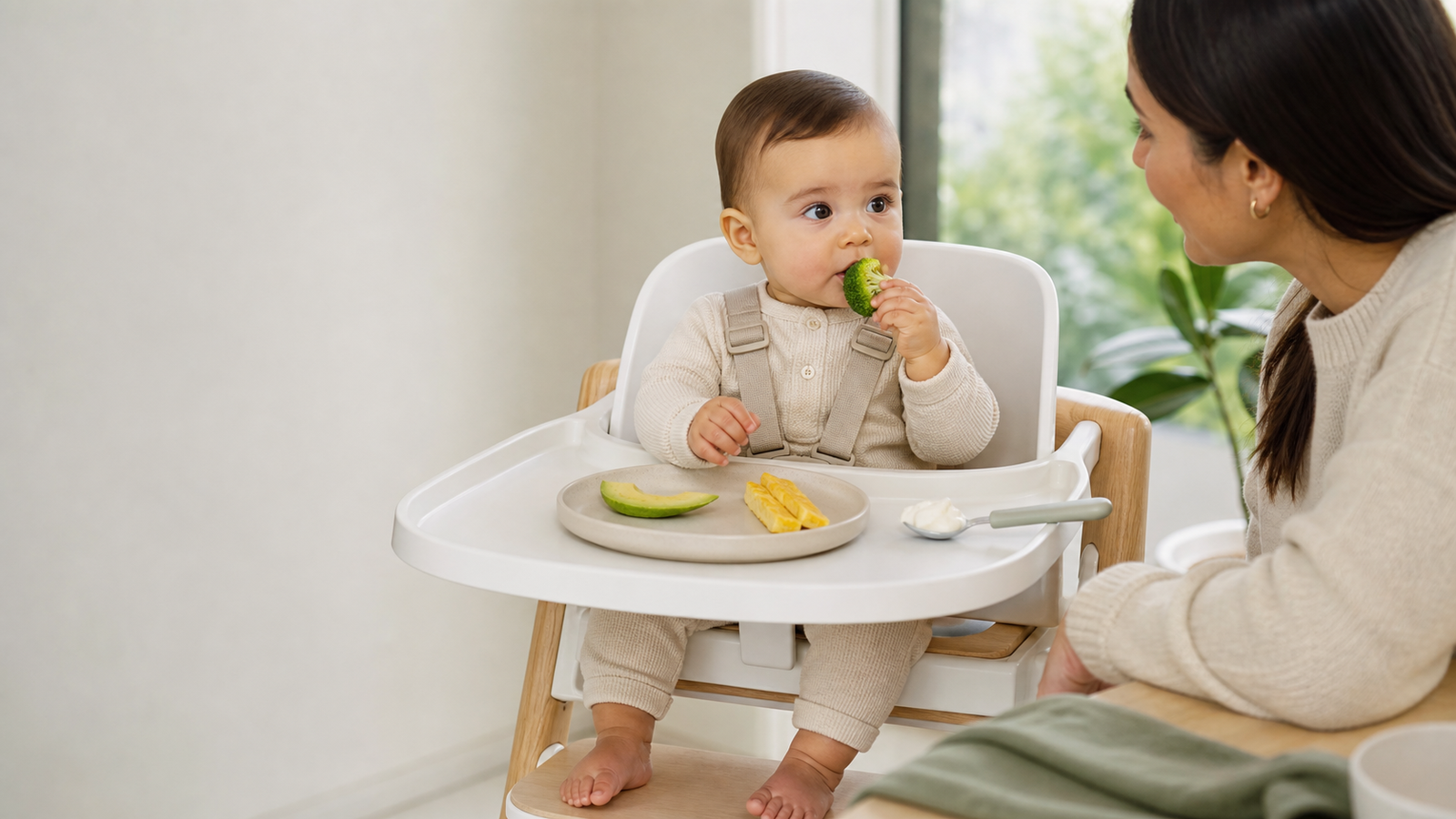
Baby-led weaning, or BLW, is one way to introduce complementary foods. It is not the only healthy approach, and it does not need to be practised rigidly. Families can combine finger foods with responsive spoon-feeding.
What is baby-led weaning?
In baby-led weaning, a developmentally ready baby is offered appropriately prepared pieces of food and allowed to bring them to their own mouth. The caregiver decides what, when and where food is offered; the baby decides whether and how much to eat.
BLW does not mean:
- giving a baby an unmodified adult meal;
- leaving the baby to eat alone;
- avoiding spoons or mashed foods;
- replacing breast milk or formula immediately; or
- allowing the baby to bite any food they can grab.
Safety and nutrition still require adult planning.
When can a baby start?
CDC and AAP guidance recommends introducing foods other than breast milk or formula at about 6 months. Starting before 4 months is not recommended.
Age is only one part of readiness. Look for a baby who:
- can sit upright with support and maintain good head and neck control;
- brings objects to the mouth;
- reaches for and grasps objects;
- swallows food rather than consistently pushing it forward; and
- shows interest in food.
Online “readiness tests” cannot evaluate every baby. Speak with your baby’s clinician before starting if your child was born prematurely, has poor growth, low muscle tone, oral-motor difficulty, developmental delay or a history of coughing or choking with feeds.
What does the evidence say?
BLW advocates associate the approach with independence, varied textures, responsive eating and less picky eating. These are plausible benefits, but research is still limited and does not confirm every popular claim.
AAP guidance notes concerns that some self-feeding diets may provide too few calories, iron or other micronutrients. Available studies suggest BLW does not necessarily cause more choking than traditional feeding when foods are prepared appropriately, but choking remains a real hazard in either approach.
The credible position is therefore neither “BLW is dangerous” nor “BLW prevents choking.” Preparation, supervision, readiness and caregiver knowledge matter.
Gagging is not choking
Gagging is a protective reflex that helps move food forward. A gagging baby may cough, make noise, open their mouth or appear red. It can look alarming.
Choking means the airway is partly or completely blocked. A choking baby may be unable to cry, cough effectively or breathe. Skin color can change.
Do not put fingers blindly into a baby’s mouth during gagging; that can push food farther back. Every caregiver should learn infant choking response and CPR from a qualified course before or while solids are introduced. An article cannot replace hands-on training.
If a baby is unable to breathe or respond, begin the appropriate emergency response and contact emergency services.
How to prepare first foods
Early finger foods should be soft enough to mash between your fingers and shaped so the baby can grasp them.
Examples include:
- soft-cooked broccoli with a long stalk;
- ripe avocado wedge rolled in finely ground food for grip;
- soft-cooked sweet potato spear;
- omelet strip cooked through;
- soft shredded meat gathered into a manageable portion;
- ripe pear or peach slice without hard skin;
- toast strip spread thinly with smooth nut butter; and
- thick plain yogurt offered on a preloaded baby spoon.
Food shape should evolve with the child’s grasp and chewing skills. Large graspable pieces may be easier early on; smaller pieces become appropriate when a more precise pincer grasp develops.
Do not use a viral photo as a cutting guide. Confirm food-specific preparation with current, reputable choking-prevention guidance.
Foods that require modification or avoidance
CDC identifies common hazards including:
- whole grapes, cherries and small tomatoes;
- raw hard pieces of apple or carrot;
- whole or chopped nuts;
- spoonfuls or chunks of nut butter;
- hot-dog or sausage coins;
- popcorn;
- hard candy and gummy candy;
- large chunks of meat or cheese;
- fish or meat with bones; and
- other small, hard, sticky or round foods.
Cook hard produce until soft. Cut round foods lengthwise into developmentally appropriate pieces. Spread smooth nut butter thinly or dilute it to a suitable texture rather than offering a sticky spoonful.
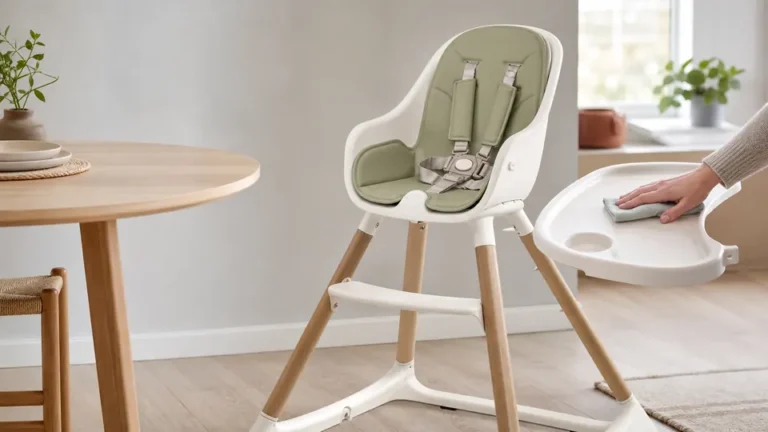
Always seat the baby upright in a stable high chair, use the harness and supervise closely. Eating while crawling, walking, reclining or riding in a car or stroller increases risk.
Build meals around nutrition, not just variety
At around six months, babies need complementary foods that provide nutrients—especially iron—while breast milk or infant formula remains an important source of nutrition.
Try to include an iron-rich food regularly:
- soft shredded meat;
- well-cooked egg;
- mashed beans or lentils offered on a spoon or in a graspable patty;
- tofu strips;
- iron-fortified infant cereal; or
- suitable fish with every bone carefully removed.
Pair plant sources of iron with vitamin C-rich foods such as soft broccoli, ripe fruit or cooked pepper.
Fruit and vegetables are valuable, but a plate made only of low-calorie produce may not provide enough energy or iron. Add nutrient-dense foods and fats in suitable forms.
Avoid added sugar where possible. Do not add salt to the baby’s portion. Honey should not be given before 12 months because of infant botulism risk.
Introducing allergens
Potential allergens can be introduced when other complementary foods begin, in forms that are safe for the baby’s development. These include egg, peanut, dairy, wheat, soy, sesame, fish and shellfish.
Introduce one potential allergen at a time, earlier in the day when possible, so the baby can be observed. Continue offering tolerated allergens regularly as part of the diet.
For peanut, never offer whole peanuts or a thick spoonful of peanut butter. Use a safely thinned preparation or thin spread.
Talk with your baby’s clinician before peanut introduction if the baby has severe eczema or an egg allergy. Seek emergency help for breathing difficulty, swelling, widespread hives, repeated vomiting with other symptoms, sudden lethargy or collapse.
A realistic first-month timeline
This is a flexible example, not a requirement.
Week 1: practise
Offer one small meal when the baby is rested. Focus on sitting, grasping and exploring. Milk feeds remain central.
Week 2: add nutrient density
Offer iron-rich foods in safe forms and begin pairing them with familiar soft produce.
Week 3: expand textures and allergens
Continue tolerated foods and introduce potential allergens one at a time when appropriate.
Week 4: move toward shared meals
Set aside the baby’s portion before adding excess salt, sugar or hard garnishes. Continue modifying shapes and textures.
Some babies eat very little during these weeks. Others progress quickly. Intake should gradually increase, but growth, wet diapers and overall feeding comfort matter more than social-media comparisons.
Combining BLW with spoon-feeding
There is no evidence-based prize for avoiding spoons. Thick yogurt, mashed beans and iron-fortified cereal can be offered responsively on a preloaded spoon or by a caregiver who follows the baby’s cues.
Do not scrape food into a closed mouth, distract the baby into accepting bites or require a clean plate. Mixed feeding can preserve self-feeding opportunities while making nutrient-dense textures easier to offer.
When to seek help
Contact your child’s healthcare team if:
- the baby repeatedly coughs, chokes or has breathing changes during meals;
- meals are consistently distressing;
- the baby cannot maintain an upright position;
- food or milk regularly comes through the nose;
- the baby has persistent vomiting;
- wet diapers decrease;
- growth is a concern; or
- the diet is very limited because of allergy, medical needs or refusal.
The bottom line
Baby-led weaning can be a practical way to introduce food when it is matched to developmental readiness and supported by careful preparation. It is not automatically superior to spoon-feeding, and it should not be presented as risk-free.
Start at about six months when your baby is ready, offer soft foods in appropriate shapes, include iron-rich choices, use a stable high chair and remain within arm’s reach. Flexibility is a strength: finger foods and responsive spoon-feeding can belong at the same table.
Sources
- CDC: When, What and How to Introduce Solid Foods
- CDC: Choking Hazards
- AAP: Baby-Led Weaning—Is It Safe?
- AAP: Starting Solid Foods
This article provides general educational information and is not a substitute for medical, nutritional or feeding advice tailored to your child.