


A beautiful nursery is optional. A safe place for your baby to sleep is not.

Crib shopping can make safety feel like a list of finishes, certifications and accessories. The fundamentals are much simpler: use a sleep product made for infant sleep that meets current federal requirements, assemble it exactly as directed, pair it with a firm, properly fitting mattress and keep the sleep space bare.
This guide explains what current U.S. crib rules address, what parents can inspect at home and which popular additions do not belong in a baby’s crib.
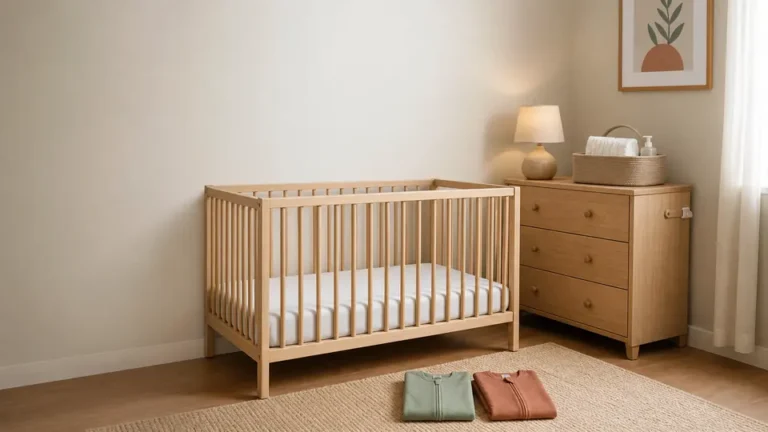
The short version: Place your baby on their back on a firm, flat sleep surface with a fitted sheet. Keep pillows, blankets, bumpers, toys and positioners out of the crib.
What changed under the current federal crib rules?
Cribs sold in the United States must comply with federal safety requirements administered by the U.S. Consumer Product Safety Commission (CPSC). The major rules that took effect in 2011 were designed to create a safer generation of cribs.
Among other changes, the rules:
- prohibit the manufacture or sale of traditional drop-side cribs;
- require stronger wood slats;
- require more durable mattress supports;
- require hardware designed to resist loosening; and
- apply more rigorous safety testing.
These requirements matter when buying secondhand. A crib that looks solid may predate the current rules, have missing hardware or have been subject to a recall. CPSC advises against trying to make an old drop-side crib usable with an immobilizer or repair kit.
It is more accurate to say that a crib meets CPSC requirements than to call it “CPSC approved.” CPSC establishes and enforces requirements; it does not award a general seal of approval to every individual crib on the market.
A practical crib-safety checklist
1. Check the model and recall history
Find the manufacturer, model number and manufacture date, usually printed on a label attached to the crib frame. Search the CPSC recalls database before using a new-to-you crib and register a new crib with its manufacturer so you can receive future safety notices.
Do not use a crib while a safety recall remains unresolved.
2. Measure the slat spacing
Crib slats should be no more than 2⅜ inches apart. Openings wider than that can create an entrapment hazard.
The slats should also be present, intact and securely attached. A crib with a missing, cracked or loose slat should not be used.
3. Inspect every piece of hardware
Look for missing, loose, broken or incorrectly installed screws, brackets and mattress-support components. Do not replace original hardware with improvised parts from a general hardware store unless the crib manufacturer specifically authorizes them.
Recheck the hardware periodically and after moving or reassembling the crib.
4. Look for hazardous decorative details
Tall corner posts can catch clothing, while large decorative cutouts in a headboard or footboard can create an entrapment risk. CPSC’s consumer checklist says corner posts should not extend more than 1/16 inch above the end panels unless they are much taller canopy-style posts.
Simple construction is often easier to inspect than elaborate decorative work.
5. Use a firm, tight-fitting mattress
Use a mattress intended for the crib and follow both manufacturers’ size instructions. There should not be a dangerous gap between the mattress and crib sides.
The mattress should be firm and flat, not sloped, padded with extra layers or propped at one end. Use only a fitted sheet made for that mattress. If the sheet pulls the mattress out of shape or comes loose, replace it.
6. Set the mattress support at the appropriate height
Use the crib manufacturer’s instructions for lowering the mattress support as your child grows. Lower it before your baby can sit or pull up, following the product manual. Stop using the crib when your child reaches the manufacturer’s stated height or developmental limit.
What should be inside the crib?
For an infant, the answer is intentionally boring:
- a firm, flat mattress;
- a fitted sheet; and
- your baby, placed on their back.
CPSC’s “Bare is Best” guidance says not to add pillows, blankets or toys. The American Academy of Pediatrics (AAP) also recommends keeping soft objects and loose bedding out of the infant sleep area.
For warmth, use appropriately sized sleep clothing or a non-weighted wearable blanket rather than loose bedding. Avoid overheating and follow the garment manufacturer’s sizing instructions.
What should stay out?
Do not add:
- pillows or infant head-shaping pillows;
- loose blankets, quilts or comforters;
- stuffed animals;
- sleep positioners or wedges;
- padded or mesh crib bumpers;
- nursing pillows;
- loungers or nests;
- extra mattresses or mattress toppers; or
- weighted blankets, weighted swaddles or weighted sleep sacks.
A product being sold for babies does not automatically make it appropriate for sleep. If a baby falls asleep in a swing, bouncer, lounger or other product not designed for infant sleep, CPSC advises moving them to a crib, bassinet, play yard or bedside sleeper that meets applicable federal requirements.
Are secondhand cribs safe?
A secondhand crib can save money, but its history matters.
Before accepting one, confirm that:
- it was manufactured to comply with current requirements;
- it is not a traditional drop-side crib;
- the model has not been recalled;
- the product label and assembly instructions are available;
- every original part is present;
- the frame, slats and mattress support are undamaged; and
- an appropriate, tight-fitting mattress is available.
Skip a crib with an unknown model, missing label, improvised repair, peeling finish, bite damage that exposes material, water damage or uncertain assembly history.
Where should the crib go?
Keep monitor and window-blind cords well outside the child’s reach. As your baby becomes mobile, also consider nearby curtains, shelves, pictures and furniture that could be pulled or climbed.
The AAP recommends room-sharing without bed-sharing, ideally for at least the first six months. That means placing the baby’s separate, safety-compliant sleep space in the caregivers’ room—not placing the baby in an adult bed.
Frequently asked questions
Does a crib mattress need to be “breathable”?
The core requirements are that the sleep surface is firm, flat, properly fitted and used with a fitted sheet. “Breathable” is not a substitute for those fundamentals and should not be treated as a guarantee against suffocation or SIDS.
Can I use a crib bumper if it is mesh?
No crib bumper is needed to make a compliant crib safe. In the United States, the Safe Sleep for Babies Act prohibits the manufacture and sale of crib bumpers. Keep the crib sides clear.
Can I incline the crib mattress for reflux?
Do not incline the sleep surface unless a qualified clinician gives case-specific instructions using an appropriate medical arrangement. Routine infant sleep should be on a firm, flat surface. Semi-reclined positioning can allow a baby’s head to fall forward and obstruct the airway.
Is a family heirloom crib acceptable?
Sentimental value cannot establish compliance with current requirements. Use an heirloom crib as decoration rather than as a sleep space unless you can verify its model, condition, parts and compliance.
The bottom line
A safe crib does not need extra padding or sleep accessories. Choose a current, compliant product; assemble it carefully; check it for damage and recalls; use a firm, tight-fitting mattress; and keep the sleep space bare.
If an accessory promises to improve the crib by making it softer, cozier, more supportive or more nest-like, pause. For infant sleep, simplicity is a safety feature.
Sources
- CPSC: Safe Sleep—Cribs and Infant Products
- CPSC: Crib Safety Tips
- CPSC: A Safer Generation of Cribs
- CPSC: Recalls
- AAP: How to Keep Your Sleeping Baby Safe
This article provides general educational information and is not a substitute for advice from your child’s healthcare professional.