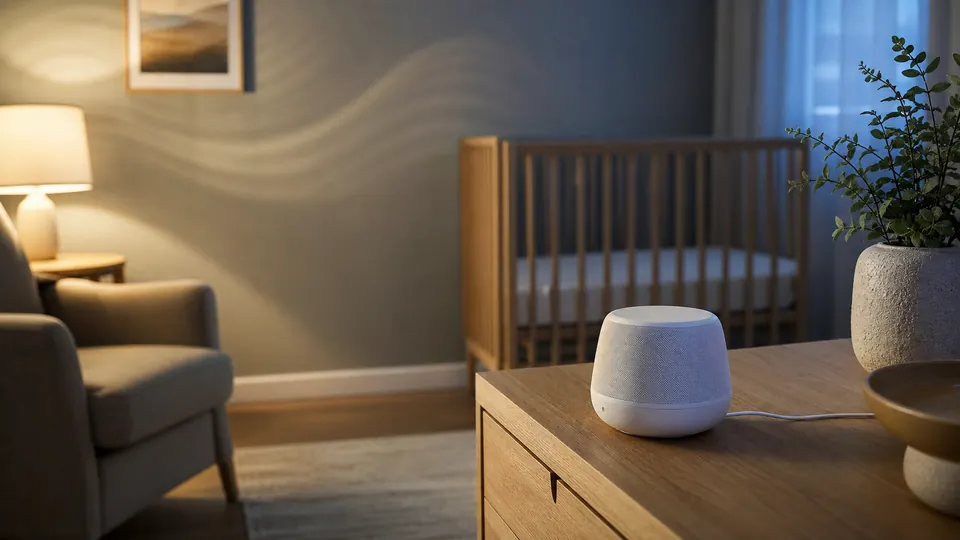

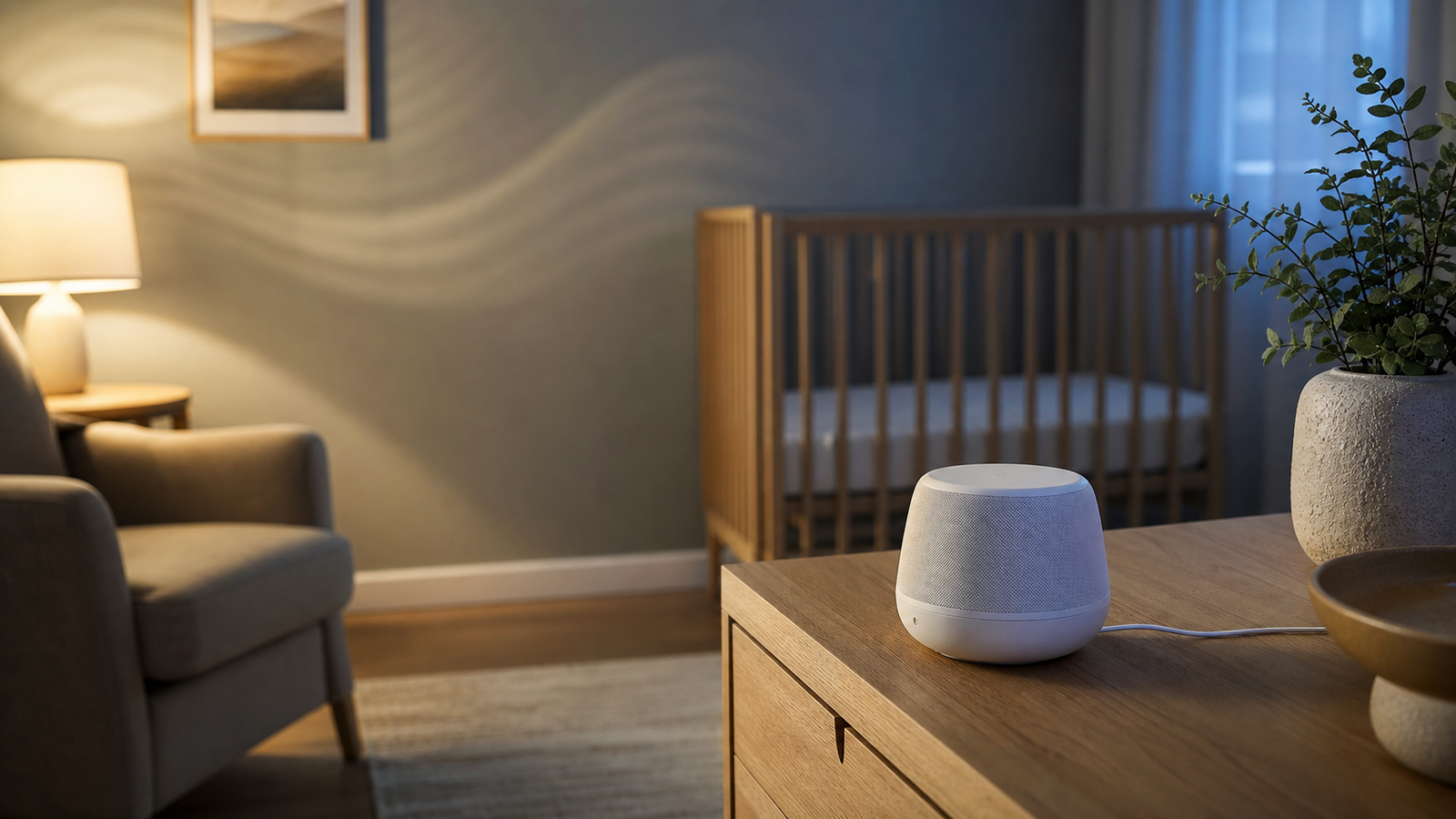
A white noise machine can soften the contrast between a quiet nursery and a barking dog, a closing door or an older child in the hallway. That makes it appealing to exhausted parents—but “helps mask household noise” is not the same as “proven to make every baby sleep better.”
Research suggests that steady sound may help some infants settle or reduce crying in particular settings. The evidence is limited, and the potential benefit has to be balanced against prolonged or unnecessarily loud sound exposure.
What counts as white noise?
True white noise contains frequencies spread evenly across the audible spectrum and often sounds like radio static. Many nursery machines actually produce:
- pink noise, which sounds deeper and softer;
- brown noise, with more low-frequency sound;
- fan or airflow sounds;
- rain, waves or nature recordings; or
- lullabies and repeated tones.
For practical nursery use, the label matters less than whether the sound is steady, kept low and placed away from the baby.
Can white noise help a baby sleep?
Possibly—but expectations should stay modest.
Small studies have reported that white noise helped some newborns fall asleep more quickly or reduced crying. Those findings do not establish that continuous white noise is necessary, that it improves long-term sleep development or that louder sound works better.
White noise may be most useful when it masks unpredictable environmental sounds. It cannot solve hunger, discomfort, illness, an unsuitable sleep schedule or an unsafe sleep setup.
A calmer environment can support a routine, but the machine should remain a background tool rather than the foundation of infant sleep.
What does the AAP recommend?
The American Academy of Pediatrics reviewed infant sleep machines as part of its guidance on excessive noise exposure. The AAP notes possible benefits but also points to machines capable of producing concerning sound levels.
If an infant sleep machine is used, the AAP advises:
- placing it as far away from the infant as possible;
- setting the volume as low as possible; and
- limiting duration of use.
You may see a universal “50-decibel rule” repeated online. That number came from research comparing machine output with a recommended noise limit in hospital nurseries; it should not be presented as a complete home-use rule or a guarantee of safety. Distance, duration, the room and the device’s actual output all affect exposure.
A cautious setup
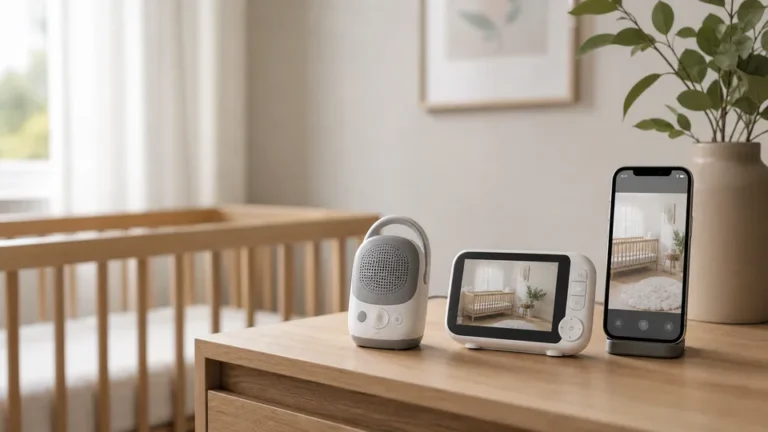
Put the machine away from the crib
Do not attach it to the crib rail or place it beside the baby’s head. Put it across the room when practical, then use only enough volume to soften disruptive noise.
Keep the power cord completely outside the child’s reach, including the reach of a baby who will later stand in the crib.
Begin at the lowest setting
Start low. If the sound dominates normal conversation at the crib, it is too prominent for its intended background role.
Phone decibel apps can provide a rough comparison but are not calibrated medical instruments. Do not use an app reading as permission to run a machine loudly or continuously.
Consider using a timer
If white noise is mainly helping with the transition to sleep, a timer or gradual fade may reduce exposure. Some families may need steady masking because of unavoidable environmental noise; in that case, low volume and greater distance become especially important.
Avoid placing a phone in the crib
A phone playing a noise app can introduce charging cords, notifications, screen light and heat. Use a dedicated device placed safely away from the sleep space if sound masking is needed.
Features worth considering
A useful machine does not need an enormous sound library. Practical features include:
- precise volume steps, especially at the low end;
- a timer or gradual fade;
- controls that can be used in the dark;
- a setting that remembers a low volume without resetting loudly;
- no bright always-on light;
- stable construction;
- a cord long enough to route safely away from the crib; and
- offline operation if you do not want another connected nursery device.
For a travel model, check how loud it starts when powered on, whether buttons can be locked and whether charging creates a loose cord near the sleep space.
Claims to treat cautiously
Be skeptical when a product claims to:
- guarantee longer sleep;
- prevent night waking;
- improve brain development;
- protect hearing simply because it has a volume limit;
- reproduce the womb at a medically optimal level; or
- treat colic or another health condition.
These claims require evidence specific to the product and outcome. A soothing sound can be pleasant without being a treatment.
White noise and sleep associations
Parents sometimes worry that a baby will become “dependent” on white noise. Consistent sleep cues are not automatically harmful, but reliance can become inconvenient during travel, power failures or childcare.
If you want flexibility:
- keep the volume low;
- use the same short bedtime routine with or without the machine;
- occasionally practise sleep in a naturally quiet setting; and
- reduce volume gradually rather than making an abrupt change.
There is no requirement to wean a thriving child from low background sound on a particular birthday. The reason to reassess is to make sure the device is still useful, appropriately quiet and safely positioned.
Frequently asked questions
Which color of noise is best for babies?
There is not enough high-quality evidence to name one “color” as universally best for infant sleep. Choose a gentle, steady sound at low volume rather than focusing on marketing labels.
Should white noise run all night?
The AAP recommends limiting duration when possible. A timer is a reasonable starting point. If environmental noise makes longer use necessary, keep the machine distant and at the lowest useful setting, and discuss hearing concerns with your child’s clinician.
Can white noise damage hearing?
Some machines can produce high output, particularly at maximum volume and close range. Risk depends on intensity and duration. That is why placement, low volume and limited exposure matter.
Is white noise part of safe-sleep guidance?
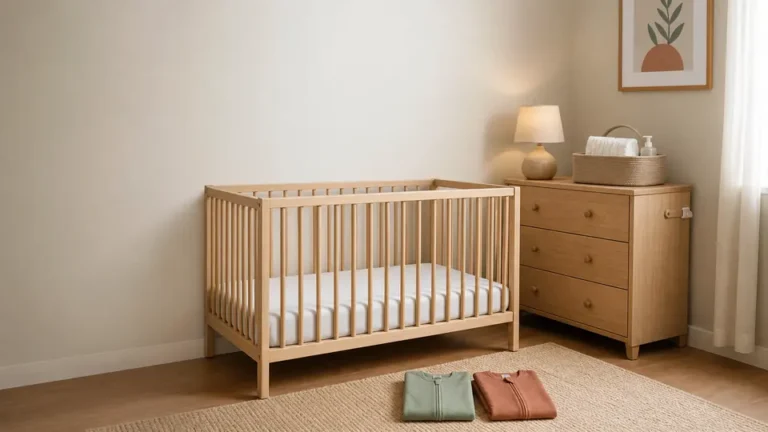
White noise is not a substitute for safe sleep. Continue to place your baby on their back on a firm, flat surface in a crib, bassinet, play yard or bedside sleeper that meets applicable requirements, with no loose items in the sleep space.
The bottom line
White noise may help some babies settle by masking unpredictable sounds, but it is not essential and the evidence does not support dramatic promises. If you use a machine, place it well away from the crib, select the lowest useful volume and limit how long it plays.
The goal is quiet background support—not filling the nursery with sound.
Sources
- AAP: Preventing Excessive Noise Exposure in Infants, Children and Adolescents
- AAP Pediatrics: Infant Sleep Machines and Hazardous Sound Pressure Levels
- CPSC: Safe Sleep—Cribs and Infant Products
This article provides general educational information and is not a substitute for medical or audiological advice.