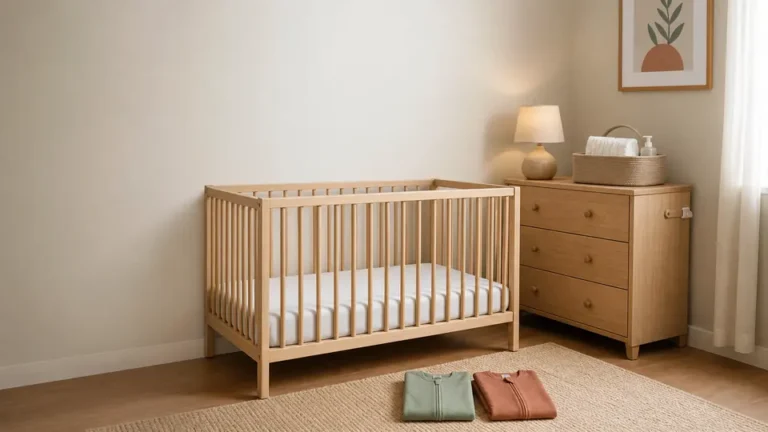

Loose blankets do not belong in an infant’s sleep space. That leaves many parents with a practical question: how do you keep a baby comfortably dressed without adding bedding to the crib?
A properly sized, non-weighted wearable blanket can be a useful option. A swaddle can also be used for some young infants, but only for a limited developmental window and with important precautions.
This guide separates those two products, explains what to look for and helps you avoid features that sound reassuring but are not supported by safe-sleep guidance.
Safety first: Do not use weighted swaddles, weighted sleep sacks or weighted blankets for an infant. Stop swaddling as soon as your baby shows signs of trying to roll.
Sleep sack or swaddle: what is the difference?
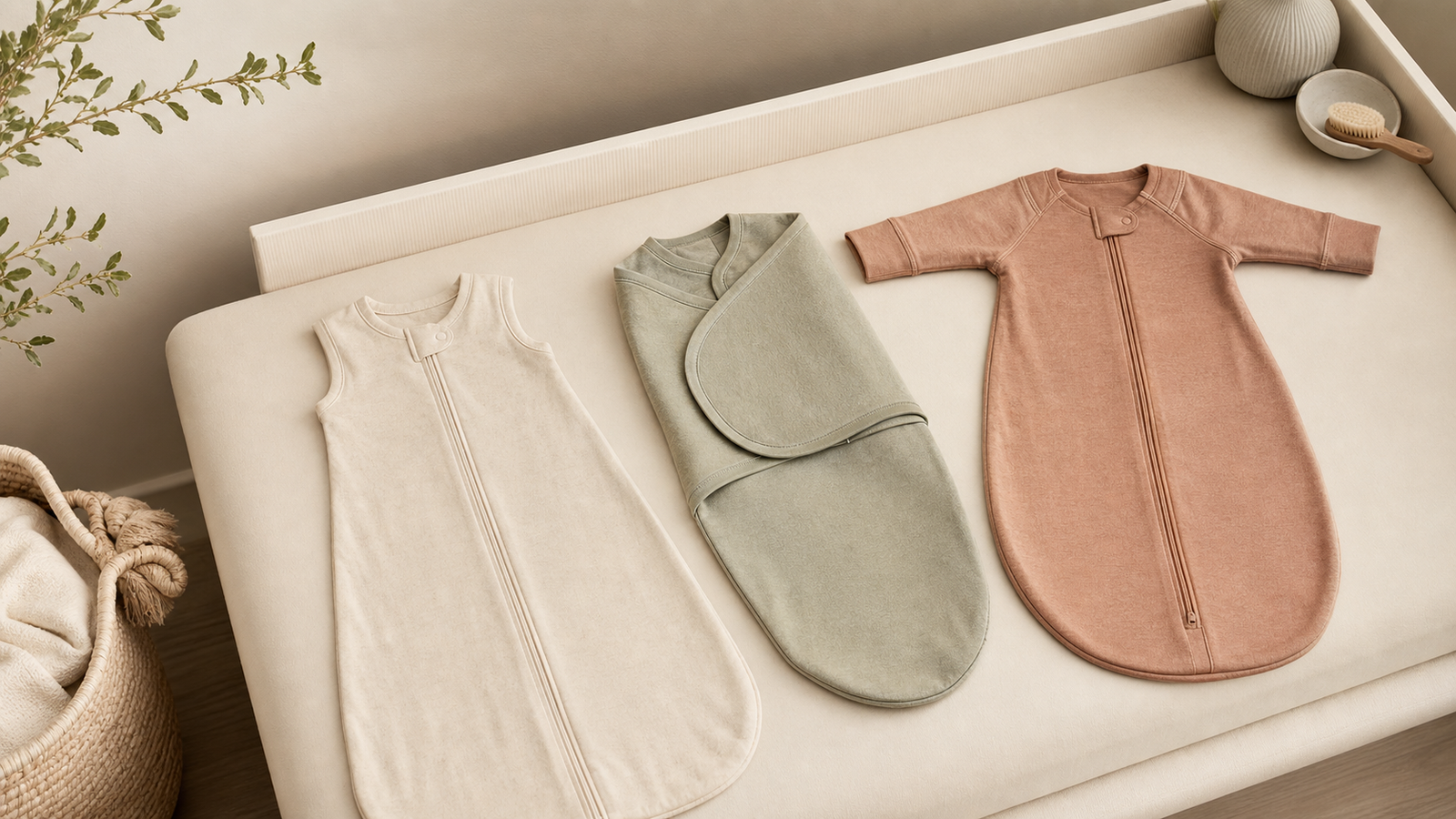
A sleep sack, sometimes called a wearable blanket, leaves the baby’s arms free and replaces loose bedding. It should fit closely enough around the neck and armholes that the baby cannot slip inside, while leaving room for the hips and legs to move.
A swaddle wraps or contains the baby’s arms and torso. It may calm some newborns, but it restricts arm movement and becomes unsafe once a baby begins trying to roll.
A “transitional” product may allow one or both arms to be released. The name does not make it automatically appropriate: check the design, fit and instructions, and do not use any arm-restricting configuration after signs of rolling begin.
Our selection approach
Fortuna Est has not presented these products as laboratory-tested or hands-on tested. This editorial shortlist is based on publicly available manufacturer specifications, non-weighted construction, sizing information, care instructions and practical design features. Availability, designs and instructions can change, so confirm current details before buying or publishing affiliate links.
No wearable product prevents SIDS, and inclusion here is not a safety certification or guarantee.
Shortlist: useful options for different needs
Woolino 4 Season Ultimate Baby Sleep Bag — best for a broad size range
Woolino’s merino-lined sleep bag is designed for babies from approximately 2 months to 2 years, with a stated minimum weight of 10 pounds. Underarm snaps reduce the armhole opening for smaller babies, while shoulder snaps and a two-way zipper help with dressing and diaper changes.
Why it stands out: A long usable size range may reduce how often families need to replace a sleep sack.
Consider before buying: It is considerably more expensive than basic cotton models. “Four season” does not remove the need to monitor the room and dress the baby appropriately. Follow the brand’s minimum weight and fit guidance rather than buying large for a baby to “grow into.”
ergoPouch Cocoon Swaddle Sack — best for an arms-in to arms-out transition
The Cocoon is a fitted newborn garment that can be configured as a swaddle and later used with the arms out. The company offers multiple sizes and warmth ratings.
Why it stands out: The convertible design can make the transition out of swaddling more straightforward than buying unrelated products.
Consider before buying: The arms-in mode must stop when the baby shows signs of trying to roll. Select by the current size chart and nursery conditions. A transition feature does not justify continuing to restrict the arms after rolling signs.
HALO SleepSack wearable blanket — best widely available basic option
HALO’s standard arms-out wearable blankets are available in multiple fabrics, sizes and warmth levels. The inverted zipper on many models is intended to simplify diaper changes.
Why it stands out: Broad availability and numerous fabric choices make replacements and seasonal changes easier.
Consider before buying: HALO also sells several different product types. Confirm that you are choosing an ordinary non-weighted, arms-out wearable blanket if your baby is rolling or has outgrown swaddling.
Burt’s Bees Baby Beekeeper — best simple cotton option
The Beekeeper is an arms-out wearable blanket made in lightweight cotton options, with an interior zipper guard and a bottom-opening zipper.
Why it stands out: A simple construction can be easier to wash and rotate for everyday use.
Consider before buying: Cotton weight and room temperature still matter. Check the current size chart carefully; neck and arm openings should not be loose enough for the baby to slip down.
aden + anais easy swaddle — best for caregivers who find blanket wrapping difficult
A structured swaddle can be easier to apply consistently than a square blanket, especially during overnight changes.
Why it stands out: Fasteners and defined panels can reduce the guesswork involved in wrapping.
Consider before buying: Fasteners need to be secure, the hips need room to flex, and use must stop promptly at signs of rolling. Check the specific model because product designs change.
How to choose safely
Start with the manufacturer’s size chart
Do not size up to extend the garment’s life. An oversized neck or arm opening can allow a baby to slip down inside. Check weight and height limits as well as age ranges, because babies of the same age vary considerably.
Return or stop using a garment if:
- the neck opening can ride over the baby’s mouth;
- the baby can pull an arm inside through the armhole;
- the zipper, snaps or seams are damaged;
- the garment is too short for free leg movement; or
- the product no longer matches the manufacturer’s developmental limits.
Leave room for hips and legs
A swaddle should not force the legs straight or tightly bind the hips. The lower portion should allow the hips to bend and the legs to move.
The International Hip Dysplasia Institute describes “hip-healthy” swaddling as allowing the legs to bend up and out rather than being tightly wrapped straight down.
Choose warmth for the room—not the season’s name
TOG is a measure of thermal insulation, not a safety rating. Two products with the same marketed season may feel and perform differently depending on fabric, fit and clothing underneath.
Use the manufacturer’s dressing guide as a starting point and check your baby for signs of overheating. The AAP advises dressing a baby in no more than one additional layer than an adult would wear comfortably in the same environment.
Sweating, a hot chest or flushed skin may indicate overheating. Hands and feet often feel cooler than the torso and are not the best guide by themselves.
Prefer simple, non-weighted construction
CPSC, CDC, NIH and AAP guidance warns against weighted infant sleep products. Added weight is not a calming feature worth considering for an infant.
Also be cautious with unsupported marketing terms such as:
- “SIDS-preventing”;
- “oxygen regulating”;
- “anti-suffocation”;
- “doctor approved” without a named, relevant standard; or
- “breathable,” when used as if it guarantees safe sleep.
No fabric claim replaces a safe sleep surface or correct fit.
When should you stop swaddling?
Stop using any product that restricts the arms as soon as your baby shows signs of trying to roll. Do not wait for the first completed roll.
Signs can include repeated twisting, rocking onto the side or using the legs and shoulders to turn. Babies reach this stage at different ages, which is why a fixed calendar date is less useful than watching development.
Once signs appear:
- Move to an appropriately sized, arms-out, non-weighted sleep sack or ordinary sleep clothing.
- Continue placing the baby on their back at the start of every sleep.
- Keep the crib bare.
- Make sure the sleep space is no longer using an arms-restricting swaddle.
If a baby can roll both ways independently, continue placing them down on their back, but you do not need to repeatedly turn them over. The crib must remain clear so the baby can move freely.
Common questions
Does a baby need a sleep sack?
No. Appropriately warm sleep clothing can also be used. A sleep sack is a convenience, not a requirement.
Are sleep sacks safe once a baby can stand?
Follow the product’s size and developmental instructions. The garment should allow safe movement and should not be so long that it creates a tripping or climbing problem when the child is awake.
Can a swaddled baby sleep on their side?
Place every baby on their back for sleep. Side sleeping is not recommended, and swaddling makes rolling into a face-down position particularly concerning because the arms are restricted.
Can I use a swaddle in a car seat?
Do not place bulky fabric or unapproved layers between the child and the harness. Car-seat use must follow the car-seat manufacturer’s instructions. A product’s travel slot is not, by itself, proof that it is approved for use with every restraint.
The bottom line
For most families, the most versatile long-term choice is a simple, non-weighted, arms-out sleep sack in the correct size. A swaddle can be an option for a young infant who is not showing signs of rolling, but it requires closer attention to fit, hip movement, warmth and developmental timing.
The best product is not the one with the most reassuring claims. It is the one that fits correctly, matches your baby’s current stage and is used within a bare, firm, flat sleep environment.
Sources
- CPSC: Safe Sleep—Cribs and Infant Products
- AAP: How to Keep Your Sleeping Baby Safe
- International Hip Dysplasia Institute: Swaddling
- Woolino: 4 Season Ultimate Baby Sleep Bag specifications
- ergoPouch: Cocoon and sleep-sack specifications
Product details were checked on July 27, 2026. Prices and specifications can change. This article provides general educational information and is not a substitute for advice from your child’s healthcare professional.